


Forearmed
2002
machine knitted wool
1360 × 1360 mm
Forewarned
2002
machine knitted wool
1920 × 1360 mm
In the collection of the Castle Museum, Nottingham
Photography: Douglas Atfield
Forearmed
2002
machine knitted wool
1360 × 1360 mm
Forewarned
2002
machine knitted wool
1920 × 1360 mm
In the collection of the Castle Museum, Nottingham
Photography: Douglas Atfield
07 June 2003


I CAN’T REMEMBE
2000 Hand knitted yarn (mixed fibres), 1195 × 340 mm
Private collection
I AM PERFET
2000 Hand knitted yarn (mixed fibres),
926 × 340 mm
Hand knitted by Jean Arkell. Private collection
DO I FIT IN
2005 Hand knitted yarn,
800 × 340 mm
Hand knitted by Freda Burgher. Private collection
I’M SO ANGRY
2005 Hand knitted yarn,
960 × 340 mm
Hand knitted by Freda Burgher
In the collection of KODE – Kunstmuseene i Bergen, Norway
WHAT ARE YOU LOOKING AT
2005 Hand knitted yarn,
1840 × 340 mm
Hand knitted by Jean Arkell
06 June 2003
Britto is an autonomous, artists’ led organisation registered as non-profit. Britto was set up in 2002 in Dhaka, Bangladesh. It is part of the world-wide network of Triangle Arts Trust, an international network of artists and arts organisations that promotes dialogue, exchange of ideas and innovation within the contemporary visual arts.
www.brittoartstrust.org
www.trianglenetwork.org
The International Artists’ Workshop brought together 19 artists from Bangladesh, France, Germany, Hong Kong, India, Indonesia, Japan, Myanmar, Pakistan and UK to live and work side by side, at Tepantor Film City, Valuka, Bangladesh.


Installation of Comfort Quilts and Long Arm of the Law
, 2003
cotton fabric, cotton wadding, cotton thread
Long Arm of the Law, 2003
cotton fabric, cotton wadding, cotton thread, handmade iron nails
Long Arm of the Law (detail)
, 2003
cotton fabric, cotton wadding, cotton thread,
handmade iron nails
Bangladeshi Comfort Creatures,
2003
yarn, plastic toys
In Private Collections
Leaf, Lips, Lipi, 2003
bamboo and plastic sieves, plastic wastepaper basket, yarn
I was filled with anxiety and apprehension about the two weeks that I was to spend in Bangladesh. I knew that there would be difficulties but nothing could have prepared me for what was the biggest difficulty of all – the dispersal of the Britto family and the knowledge that we would never be together again. I am left deeply affected by the relationships that I made and the different cultures that I experienced.
I worked on three projects for Britto which were initially inspired by the materials and skills which could be bought locally. For the Open Studio Day the projects were installed together in a building which was under construction. The entrance to my installation, The Long Arm of the Law, was marked by a hank of wool. This was the symbol used to indicate that there was wool for sale in the market in Dhaka, albeit unraveled from pre knitted jumpers!
My first project was a small series of dolls, which were related to a series of Comfort Creatures which I had made in the UK. These were made from plastic toys and the reclaimed wool. Making these new Bangladeshi Comfort Creatures was a way of dealing with the initial anxieties that I felt about working in an alien environment, in front of strangers and without my usual access to materials and skills.
The second project took the form of a huge embroidered face. This was taken from the cover of one of the many children’s’ alphabet books that I bought. The eyes were embroidered onto plastic sieves, whilst the nose was worked on a plastic wastepaper basket. The lips were represented by a leaf embroidered onto a round bamboo sieve. This image was taken from an educational chart, showing the parts of the human body, where the lips had been mislabeled as “leaf”. For me this mistake symbolized the many cultural misunderstandings that exist and represented my inability to speak even the simplest word in Bangla whilst everyone around me could speak my language.
The final project was a series of figurative quilts based on drawings that I had been doing just before I left the UK. The making of the quilts was inspired by how surprisingly cold it was at night and were a way of working with a textile process, other than that of knitting which I usually work with. Four distorted figures and a gun were made in conjunction with a local tailor and quilter. This was a very constructive, enjoyable collaboration, which also enabled me to spend a lot of time in the local market. I felt that I should re-title the workshop “Britto International Artists’ Shop”.
“Britto, better than the best”.
(Statement written for the catalogue for Britto International Artists’ Workshop – 2003.)
01 May 2003


Common Enemies
2002 Cotton and woollen yarn, flyswats
100 × 800 mm
Private collection.
Common Enemies
- Mosquito
2003 Yarn, bamboo sieve
500 × 1250 × 50 mm
Common Enemies
- Water
2003 Yarn, bamboo sieve
500 × 1250 × 50 mm
The “Common Enemies” Series (2002 – 2006) began with a moth. This is an “enemy” to those of us who work with wool but also, I discovered, to those of us who work with computers. In 1945 Grace Murray Hopper, who was working on the relay-based Harvard Mark II computer, found the first computer bug, a moth, jamming the relays of her computer. It was taped in the log-book alongside the official report, “First actual case of bug being found”. When I was on residency in Bangladesh I found other “enemies”. I lived in morbid fear of infected water and malarial mosquitoes. I worked these two pieces onto bamboo sieves that I bought in a local street market.
08 April 2003

2002
machine knitted wool
1800 × 580 mm
installed at firstsite at the Minories Art Gallery, Colchester
Photography: Douglas Atfield
07 June 2002

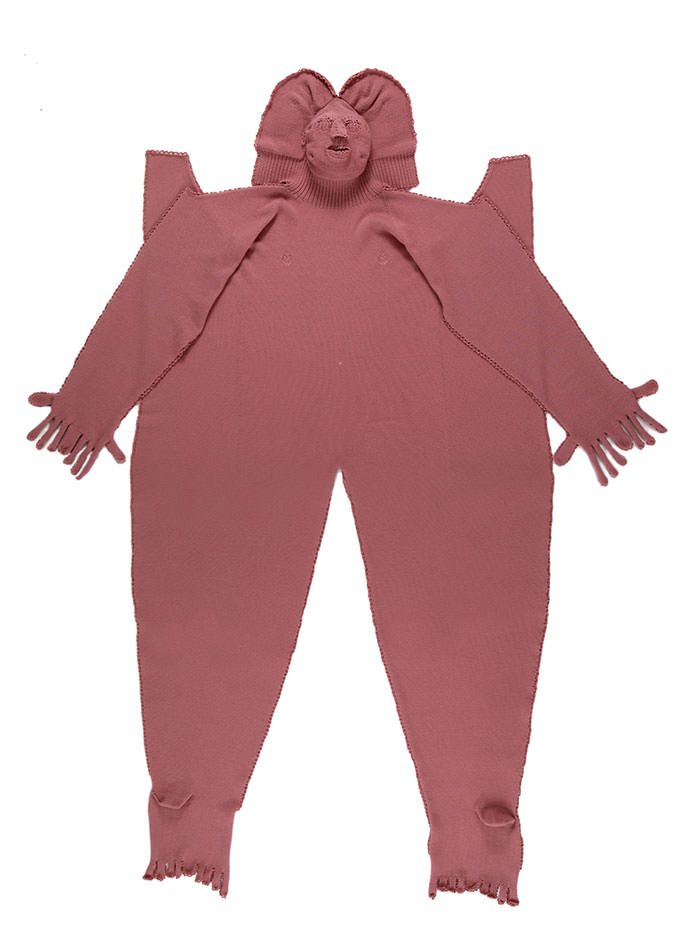
2002
machine knitted wool
2100 × 1900 mm
Photography: Douglas Atfield
07 June 2002

2001
machine knitted wool
600 × 600 mm
Private Collection
This piece is a natural progression for me. For the past couple of years I have been working on a series of distorted body pieces. These knitted “jumpers” have a sleeve instead of a neck, a spare torso projecting from the stomach, four shoulders with four sleeves and sealed cuffs for missing hands. The series culminates in two full bodies joined at the head. A piece which two people can enter but which otherwise lies or hangs like an empty skin. My research has been around the human body, medicine, disability and disfigurement, the freak show, taxidermy, mummies, religious iconography and other “curiosities”. I find the medium of knitted textiles a powerful tool for expression and communication because of the cultural preconceptions surrounding the area. It is a “friendly” medium, which can be used to engage your audience with a subject, which might otherwise cause them to turn away.
In “Billy Wool” I tackle the head with features. A piece, which presents more technical challenges than any of my previous work. The whole piece is knitted on a domestic knitting machine with many of the stitches being moved around and worked by hand. The final piece is more of a skin than a balaclava. When it came off the machine and lay on the ironing board it resembled a mummified body. In particular Lindow Man, who has become known as “Pete Marsh”, hence its’ title, “Billy Wool”.
(Written statement for Ikons of Identity, a Craftspace touring exhibition 2001 – 2002)
07 June 2001

2001
machine and hand knitted wool, cotton and elastic, pompoms, buttons, glass heads
installed at firstsite at the Minories Art Gallery, Colchester
This series of work was inspired by the 17th century “scold’s bridle” which was used to punish scolds or gossips. These were, of course, primarily women as are the majority of knitters. I became interested in the idea of producing your own form of torture or punishment. Sitting down and doing something passive, creative and “useful”, such as knitting, only to have it used to punish or torture you. These cute, friendly, fluffy pieces beguile their actual use. Having the pompom in your mouth is a revolting experience, which would soon choke you. In “Wise Monkeys” the idea is taken further to also prevent you from using some of your other senses. You hearing is muffled by the pompoms. You eyes are blinded, being replaced by the traditional knitted toy’s eyes, the button.
The large bridle piece is based on an actual “scold’s bridle” in the Royal Armouries in The Tower of London. This piece contrasts pleasure with pain. The bridle is “plated” (lined) with cashmere yarn and, where as the original bridle had a serrated iron tongue for insertion into the mouth, this has a cashmere and mohair pompom. This piece also has pompoms to muffle your hearing and fastens around the face by the use of buttons instead of an iron padlock. The title “Wise Monkeys” comes from those Three Wise Monkeys who could “Hear no evil”, “See no evil” and “Speak no evil”.
(Written statement for Ikons of Identity, a Craftspace touring exhibition, 2001 – 2002)
07 June 2001

2001 Knitting, hand embroidery, machine embroidery and heat transfer on found domestic linen. 150 × 125 mm – 240 × 920 mm Private collection.
Lot 1189 Eighteen coloured table mats, fringed, and a quantity of d’oyleys, odd serviettes and pieces of linen.
At the back of most linen or airing cupboards you will probably find these eighteen coloured table mats, a quantity of d’oyleys, odd serviettes and pieces of linen. These items were once essential to every household but are now mostly redundant. I will look at their supposed function and the role that they played in every woman’s life. So much stitching, washing, starching, pressing and storing. These items represent so many hours of hard work and to what end? I often use word games to further my ideas and will employ this technique to come up with other forms that these textile items might take.
PIECES OF LINEN
PIECES OF LENIN
In response to all of this I will produce a series of contemporary textile pieces which, like the list above, may form a rather motley assortment of items which have come together through chance rather than intention. I will use both old and new materials, incorporating traditional techniques such as knitting, stitching and embroidery. (Statement taken from proposal for “A Public Auction of Private Art Works”, 2001) www.somewhere.org.uk/auction
07 June 2000


Mat Fraser wears “SHORT ARMED AND DANGEROUS”
2000
Machine knitted wool
730 × 480 mm
Catherine Long wears “AT ONE”
2001
Machine knitted wool, hand embroidered cotton yarn
460 × 400 mm
Commissioned by The City Gallery, Leicester
for Adorn, Equip, an exhibition discussing issues surrounding design and disability.
BODY NO BODY S0ME BODY ANY BODY
Wordplay formed the basis of these two commissions made for, and in conjunction with, Mat Fraser and Catherine Long. Strong, confrontational wording with an element of humour and the unexpected.
Disability has long been the butt of jokes. I can remember the one about the one legged, one armed man who was getting on the bus and the bus conductor said to him, “Hop on, you look (h)armless”. I wanted to turn these and other “accepted” jokes and sayings upside down. With Mat, who has short arms, we also wanted to challenge the commonly held assumption that disabled people are passive and somehow harmless. I originally had the wording ARMLESS AND DANGEROUS in mind, a play on “Armed and Dangerous”. Mat is far from harmless but, as he corrected me, he is not armless either. He is in fact SHORT ARMED AND DANGEROUS. This exactness of language is very important. It is not about political correctness, it is about thinking, caring and acceptance. Catherine has one arm, she does not only have one arm. The “only” implies some kind of loss or deficiency which is far from the truth. We used the word ONE on both her sweater and glove. Her glove has the word ONE embroidered across the knuckles, where you might otherwise have “love” or “hate” tattooed. When she holds her clenched fist up and flicks out her thumb it has the word UP embroidered on it. She is ONE-UP. The tattoo theme was taken through into her sweater. She has a butterfly and a bunch of daisies, symbols which have significant personal meaning for Catherine, embroidered onto her shoulder. There is a banner running through the daisies, which reads AT ONE. She is at one with her one arm, why aren’t you?
(Written statement for “Adorn, Equip”, a Leicester City Gallery touring exhibition, 2001 – 2002)
07 June 2000
Page 6 of 8