Basketcase, 2015, machine knitted wool, crocheted lurex, wicker basket,
260 × 520 × 260 mm
Photography: Douglas Atfield

Basketcase, 2015, machine knitted wool, crocheted lurex, wicker basket,
260 × 520 × 260 mm
Photography: Douglas Atfield
01 April 2015
Curated by David Littler
Cecil Sharp House – the north London home of the English Folk Dance and Song Society (EFDSS) – Camden, London NW1
15 May – 25 September 2014

Collection of Knitted Folk Objects – Pocky, 2014, machine knitted wool, reclaimed knitting needles, 700 × 400 × 120 mm

Collection of Knitted Folk Objects – Cecil, 2014, machine knitted wool, reclaimed knitting needles, wood, 240 × 100 × 1220 mm

Collection of Knitted Folk Objects – Mither, 2014, machine knitted wool, reclaimed wooden walking stick with metal badges, stones, 1050 × 160 × 100 mm. Private Collection

Collection of Knitted Folk Objects – Walkin-Stick, 2014, machine knitted wool, reclaimed bamboo walking stick, rubber ferrule, expanding foam

Collection of Knitted Folk Objects – Old Nanny Witch , 2014, machine knitted wool, reclaimed wooden walking stick, stones, ribbon, kilt pin, 500 × 100 × 980 mm. Private Collection
Yan Tan Tethera – which is a traditional sheep counting system used predominantly in the north of England as well as a way to count stitches in knitting – explores, shares and brings to life some of the songs and dances that have eminated from, and been inspired by, England’s textiles industry. Spanning five months, the wider Yan Tan Tethera project, a season of performances, events, workshops and exhibition, takes over Cecil Sharp House and spills into the local Camden area.
Freddie Robins’s finished works are heavily influenced by the old children’s rhyme, “Tell-tale tit”. It is the ultimate playground insult, you have a disabled father who cannot walk, even with a walking stick, and a mother who cannot knit!
“Tell-tale tit, yer mither cannae knit,
Yer father cannae walk wi a walkin-stick.”


Cabinet of Textile Folk Curiosities, 2014
“The Cabinet of Textile Folk Curiosities contain an eclectic and idiosyncratic collection of objects and research relating to songs and dances found in the Vaughan Williams Memorial Library here at Cecil Sharp House, the Full English Digital Archives and beyond. The main focus of my research has been around the theme of knitting but has also gone on to encompass the broader subject of textiles, fibre and textile production. My research has also strayed into other areas of personal interest; my home village of Rottingdean in East Sussex, (also home to the famous Copper Family), the much maligned county of Essex where I now live, places that I have visited and to where I have an emotional bond, witches and witchcraft and the sensational murders immortalized in the popular Broadside Ballads. My research, love of wooden soled footwear and desire to spend more time immersed in the activities of the English Folk Dance and Song Society (EFDSS) at Cecil Sharp House has also seen me start clog dancing classes with Camden Clog.”
The other Yan Tan Tethera artists are Shane Waltener, Prick Your Finger (Rachael Matthews), Stewart Easton, Celia Ward, the McGrath Makers’ Group, and artists from the collective sampler-cultureclash – Jason Singh, Hector MacInnes, Anne Martin and Aimee Leonard.
Yan Tan Tethera is curated by David Littler, promoted by the English Folk Dance and Song Society (EFDSS) and supported using public funding by the National Lottery through Arts Council England.
Yan Tan Tethera on film
Filmed and edited by Roswitha Chesher
Studio photography: Douglas Atfield
20 September 2014
Blackwater Polytechnic, Feering, Essex
6 – 7 and 12 – 14 July 2013


Works left to right: Typoretum (Justin Knopp), Emery Whitworth

Works left to right: Freddie Robins, Paula Kane, Ben Coode-Adams
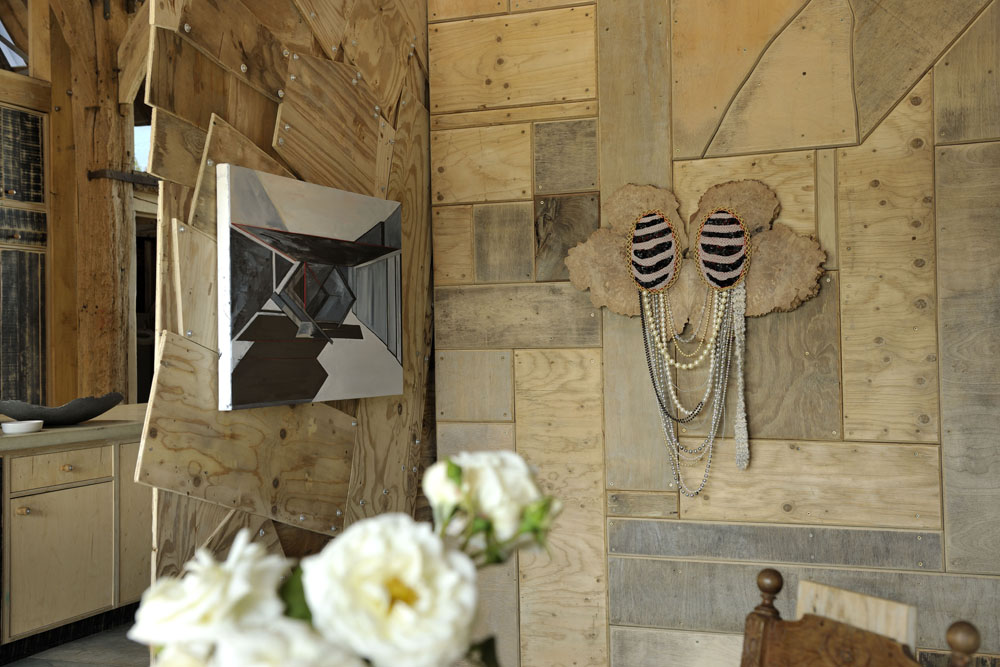
Works left to right: Rosalind Davis, Freddie Robins

Works left to right: Ben Coode-Adams, Freddie Robins
Works on white cabinet: Leigh Cameron, Freddie Robins

Blackwater Polytechnic presents an exhibition of exceptional construction in wood, textiles, ink, paint, metal & concrete made by men and women with their hands.
Happy Days presents the self-sufficiency and mental toughness of a group of artists whose work ploughs its own furrow. These artists are above all true to them- selves. And through commitment to a unique vision make amazing work. They are wildly different but together add up to more than the some of their parts.
All the artists in this exhibition share a sense of quality and joy of materials, some embracing the broken, damaged and fixed, some creating the perfect surface. In defiance of the quick fix they use craftiness and skill to create resonant structures and surfaces.
The artists offer the ‘consolation of the considered detail’ whether on an architectural wall slab or on a jewel encrusted finger of flint. Their work embraces the local, the emotional and handicraft. Building is our art.
Phrase taken from John Pawson, A Visual Inventory, Thames and Hudson, 2012
(Statement by Ben Coode-Adams, taken from www.blackwaterpolytechnic.com)
Exhibiting alongside: Leigh Cameron, Ben Coode-Adams, Rosalind Davis, David Gates – The Rural College of Art, Sara Impey, David Howe, Paula Kane, David Kefford, The Paintbox (Emery Whitworth), Annabel Tilley, Typoretum (Justin Knopp) and Sonia York.
Photography: Douglas Atfield
07 August 2013
Saatchi Gallery, London
10 – 13 May 2013
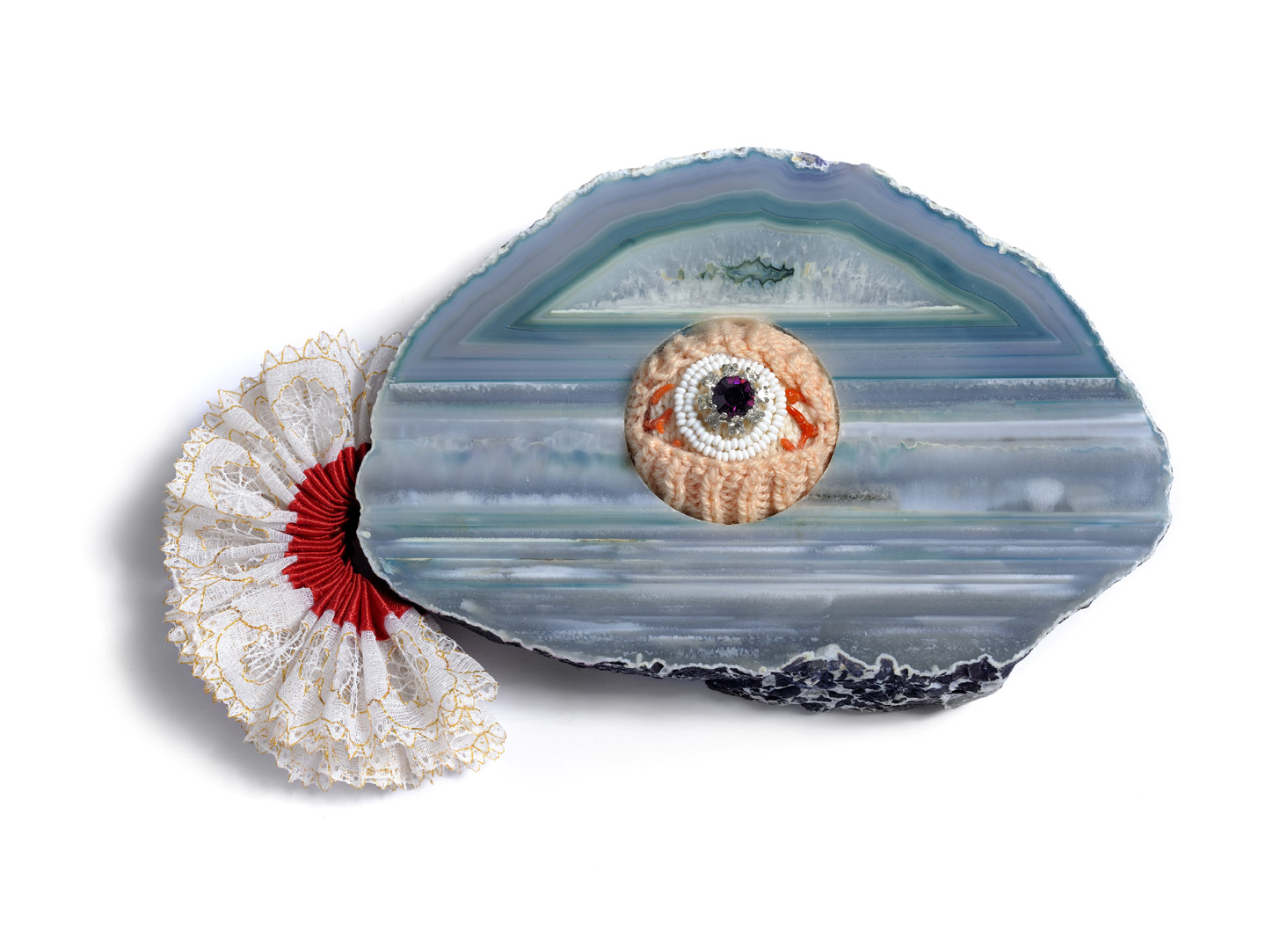
I, 2013
machine knitted wool, glass beads, coral, antique earring, polished agate and lace, 130 × 210 × 50 mm. In Government Art Collection.

Limb, 2013
machine and hand knitted wool, crochet wool, expanding foam. glass beads, lace, dress pins, sequins and antique faux pearl necklace, 140 × 200 × 640 mm

i, 2013
machine knitted wool, hand crocheted wool, nails, beads, antique glass jewellery, polished agate on maple wood plaque, 180 × 200 × 50 mm. Private Collection

Bad Mother, 2013
machine knitted wool, machine knitted lurex, expanding foam, knitting needles, glass beads, sequins, dress pins, crystal beads on maple wood shelf, 780 × 160 × 160 mm. In the Private Collection of Rosalind Davis and Justin Hibbs.

Still Breathing, 2013
machine knitted wool, hand embroidered wool, hand crocheted lurex, coppered nails, sequins, beads, antique faux pearl necklaces, antique crystal necklace on maple wood plaque, 820 × 1000 × 80 mm


One Letter Apart, 2013
machine and hand knitted wool, hand crocheted wool, expanding foam, ball of sisal, second-hand hand knitted wool glove, antique glass bead necklace, flints, sequins, glitter, mohair yarn, dress pins on oak base, approx 1700 × 550 × 430 mm

A Perfectly Good Marriage, 2013
machine knitted wool, expanding foam, hawthorn log with horse shoe embedded in it, flints, sequins, dress pins on oak, cherry and spruce wood stand, 360 × 440 × 1640 mm

Hacked, 2013
machine knitted wool, expanding foam, second-hand hand knitted wool glove, mohair yarn, beads, sea bamboo beads, balls of wool on hacked steel and wool IKEA stool (designed by Carmel McElroy and Graeme Findlay), 440 × 360 × 980 mm

Out on a Limb – samples and surpluses, things donated and inherited and found, domestic craft, mass manufacture, exquisite craftsmanship, embellished and encrusted, excess, needless, disembodied, immense violence, fear, loss, death, pain, pins and needles, and wool.
Portrait: Sophie Mutevelian
Installation photography: Ben Coode-Adams
Studio photography: Douglas Atfield
10 March 2013
Smiths Row, Bury St. Edmunds, Suffolk
11 July – 1 September 2012


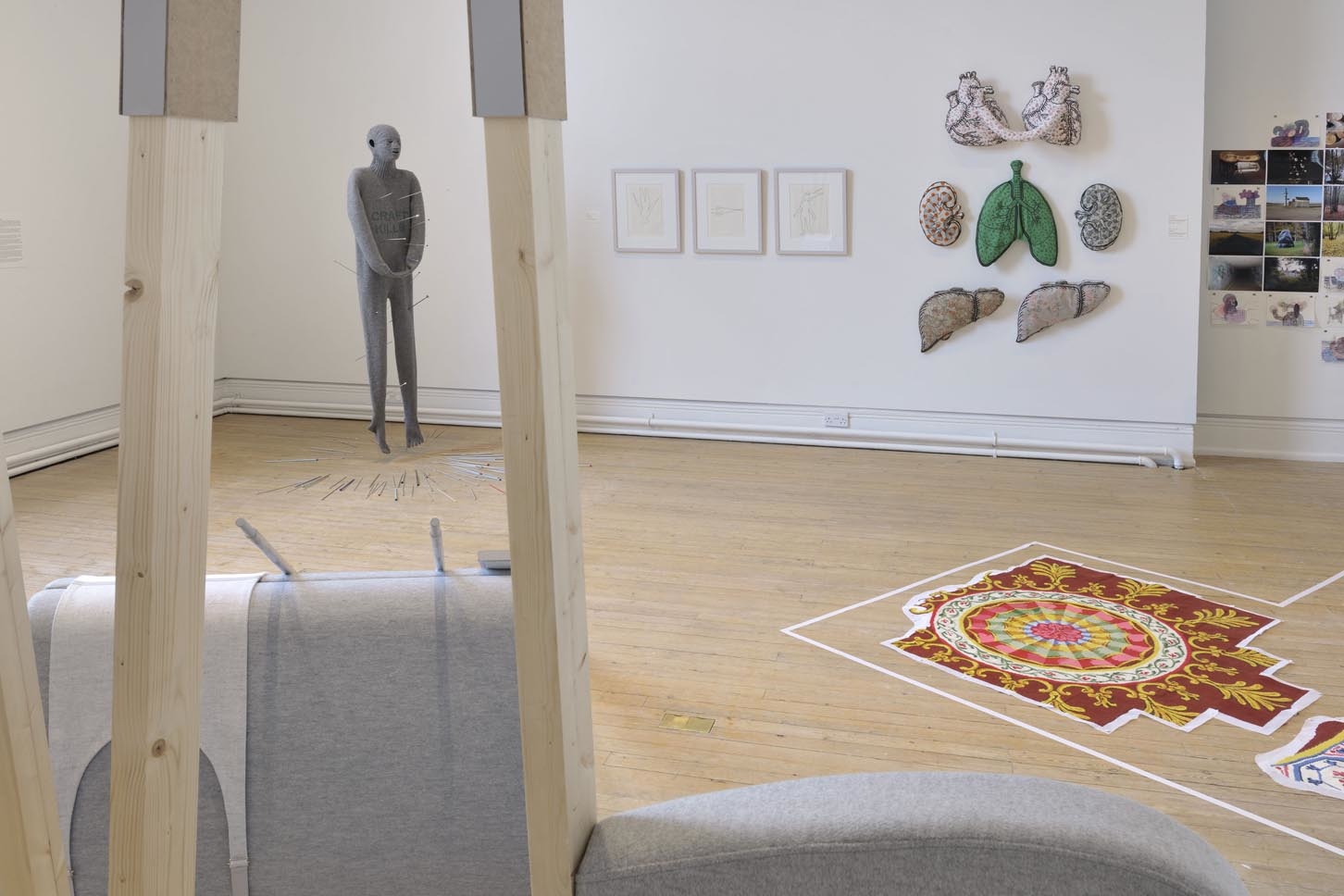

Untitled drawings, 2006 – 2011, ink on paper, 370 × 460 mm
Heart 2 Heart, Kidney Stones, Spots on your Lungs, Paisley Kidney, Lily Livered and Floral Liver, 1996
screen-printed cotton, wadding,150 × 125 mm – 240 × 920 mm
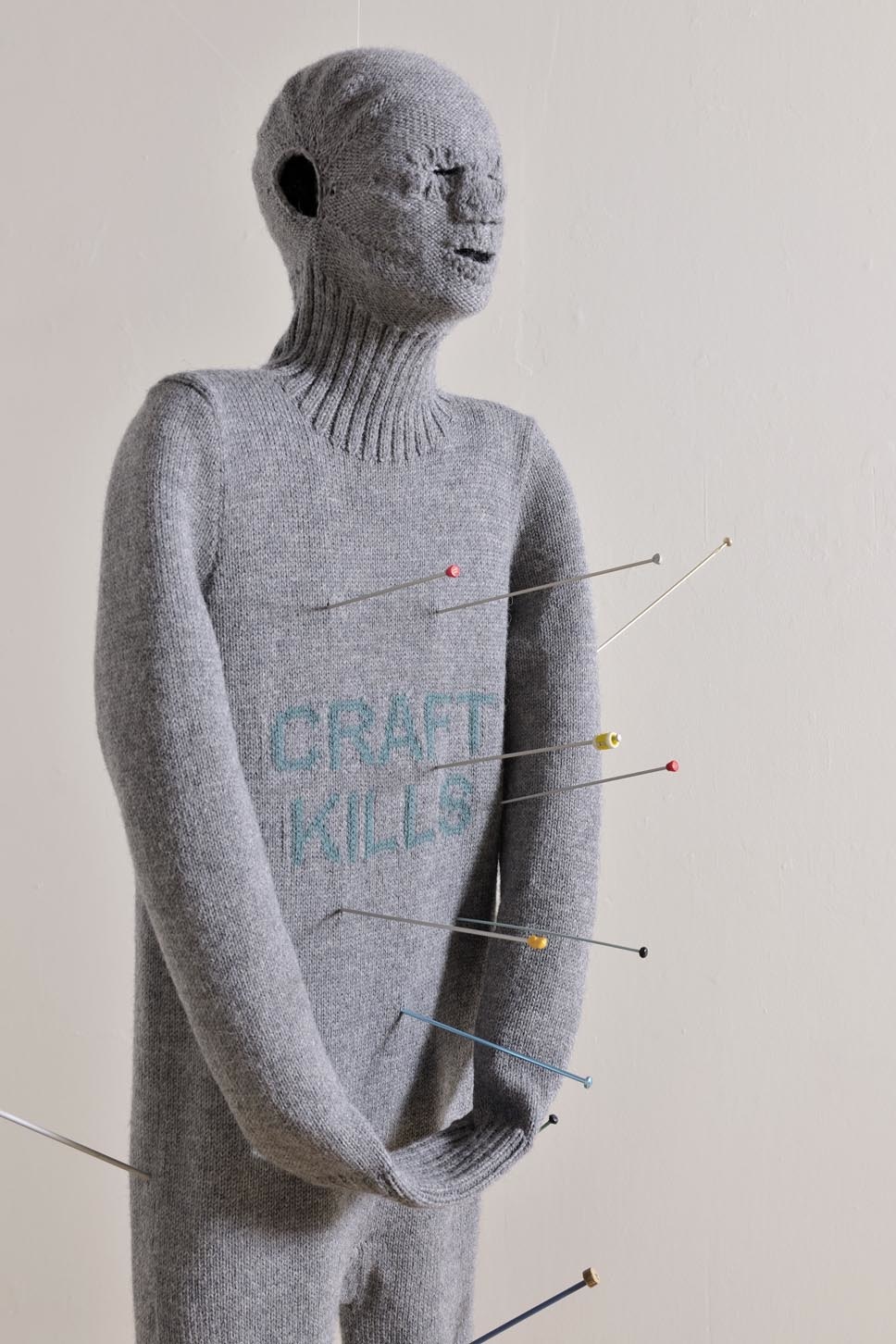
Craft Kills, 2002
machine knitted wool, knitting needles, 2000 × 680 × 380 mm
Transformations is part of the celebrations marking Smiths Row’s 40th anniversary. It focuses on the work of a number of leading UK artists they have supported throughout their history. Their work was shown at Smiths Row at the beginning of their careers and for many of them it has made a big difference to their onward success.
Small, publicly funded galleries, such as Smiths Row, play an important role in supporting early and mid-career artists by providing opportunities to exhibit, create new work and professional training which enables them to move “up the ladder” to exhibit at major London or international galleries that do not have the remit or capacity work with them in their early careers.
Out of all the artists they have worked with over the years these artists have been selected because their work explores seeming contradictions within their use of media and a tendency to subvert conventions within contemporary visual art, particularly in using craft techniques.
(Taken from www.smithsrow.org)
Exhibiting alongside: Catherine Bertola, Maxine Bristow, Susan Collis, Ben Coode-Adams, Roger Hiorns, Haroon Mirza and Caroline Wright.
Photography: Douglas Atfield
11 July 2012
Curated by Day + Gluckman
Collyer Bristow Gallery, 4 Bedford Row, London
26 May - 21 September 2011


He’s behind you, 2011, machine knitted yarn, metal coat-hanger, found wardrobe, 900 × 600 × 1640 mm
Untitled drawings, 2006 – 2011, ink on paper, 370 × 460 mm
An exhibition of iconic John French prints, from the V&A Archive, alongside highlights from the Museum and Study Collection at Central Saint Martins College of Art and Design, bespoke visualisations by FABRIC, work by WESSIELING, Carole Evans and new commissions by artists Alice Angus of Proboscis with Fee Doran (aka Mrs Jones) and Freddie Robins.
John French (1907-1966) created some of the most iconic photographic images in British fashion. Developing techniques that highlighted contrast, to work with the new mass media printing of images in newspapers, he secured fashion imagery a consistent place on the front page. In the early 1950s his jauntily posed models reflected the mood of buoyant confidence being promoted and spun by the British government. The 1951 Festival of Britain provided post-war Britain a conduit to re-secure its international standing through a celebration of new technologies, science and culture.
At the same time women, who had been essential to the war effort, were expected to return to the home and rebuild family life. 2011 marks 60 years since the Festival of Britain. Looking at the 1950’s as a starting point this exhibition considers the implications of those changing times, including the beginnings of feminism. The Museum and Study Collection at Central St Martins holds printed fabrics and items that document the beginning of women becoming stakeholders and gaining creative freedom within the fashion and textile design worlds.
(Taken from www.dayandgluckman.co.uk)
26 May 2011
16 June – 25 July 2010
Jerwood Space, 171 Union Street, London
http://jerwoodvisualarts.org/3512/Jerwood-Contemporary-Makers-2010/243
Touring to: Dovecot Studios (with IC: Innovative Craft), Edinburgh and the National Craft Gallery, Kilkenny, Ireland.
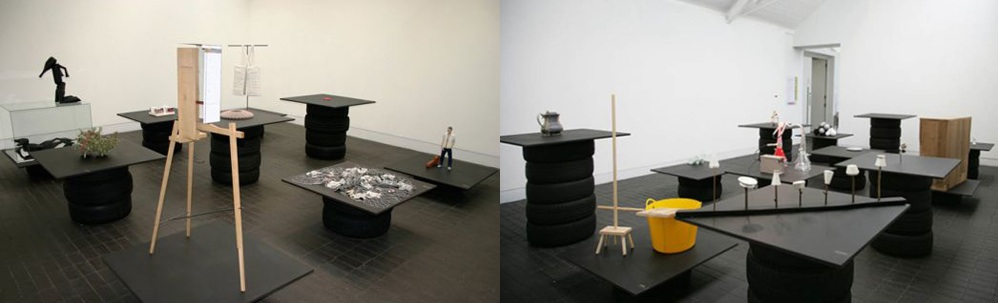

Jerwood Contemporary Makers showcased work by the new generation of UK makers. The exhibition investigated the notion of making by bringing together a broad range of work from across craft and the visual arts. Twenty-nine makers took part, each exhibiting one work and receiving an equal share of the £30,000 prize fund. A catalogue was designed by Turnbull Grey, in the form a newspaper broadsheet with an essay, The Making Game, commissioned from author Jeanette Winterson. A series of Monday evening events accompanied the exhibition. These included Emmanuel Cooper (ceramicist and craft writer) in conversation with Hans Stofer, Richard Slee and Freddie Robins also a panel discussion exploring the notion of amateur making, chaired by Stephen Knott, with Emma Shercliff. At the National Craft Gallery, Kilkenny, Ireland Freddie Robins conducted a gallery tour and delivered a lecture and workshop on Curating Contemporary Craft alongside curator and artist David Littler.
The 2010 Jerwood Contemporary Makers were: Laura Ellen Bacon, David Rhys Jones, Laura Potter, Chien-Wei Chang, Kirsty McDougall, Tomoaki Suzuki, David Clarke, Nicola Malkin, Ingrid Tait, Carl Clerkin, Taslim Martin, Marloes ten Bhomer, Julie Cooke, Flora McLean, Maud Traon, Robert Dawson, Rowan Mersh, Richard Wheater, Nora Fok, Gareth Neal, Conor Wilson, David Gates, Karen Nicol, Emma Woffenden, Joseph Harrington, Heather Park, Dawn Youll, Tony Hayward and Lina Peterson
The exhibition, designed and built by Michael Marriott, took visitors on a visual journey through the different approaches to the art of making, highlighting its importance as a visual arts discipline. Jerwood Contemporary Makers is the UK’s only award for the applied arts and is a major strand of the Jerwood Visual Arts programme.
Jerwood Contemporary Makers was launched by the Jerwood Charitable Foundation in 2008 as a three-year exhibition series supporting and showcasing emerging creative talent. Each year, a different panel of selectors has curated the exhibition, inviting a group of makers to respond to a different guiding concept.
16 June 2010
Curated by Judith King
Belsay Hall, Castle and Gardens, Northumberland
1 May–26 September 2010


Woodland Unhappy Families 2010, mixed media installation commissioned for Extraordinary Measures
Leading contemporary artists were commissioned to fill the grounds and rooms at Belsay Hall, Castle and Gardens, a property in the care of English Heritage near Newcastle. The exhibition Extraordinary Measures explored and played with our concept of scale, taking visitors of all ages into an Alice in Wonderland world of dark enchantment.
Extraordinary Measures is the sixth in a series of contemporary art exhibitions to be staged at Belsay. Simon Thurley, Chief Executive at English Heritage, said: “Every few years, we offer Belsay up to the cream of contemporary artists, giving them the opportunity to use the estate as a blank canvas for their imagination. New art and great heritage should not exist in separate closed-off worlds. So next summer, within the ancient rooms and beautiful gardens of Belsay, visitors will discover a universe where the miniscule is made massive and huge surroundings hide tiny surprises”. (Taken from Press Release for Extraordinary Measures, 2010)
Exhibiting alongside: Mat Collishaw, Tessa Farmer, MGA (Jenny Gillatt and Tim Mosedale), Ron Mueck, Mariele Neudecker, Slinkachu and Ciaran Treanor
01 May 2010


Installed at PM Gallery & House, London
2008
Antique mirror, mixed media
Last year my parents-in-law found a young, female woodpecker lying dead in an empty bedroom. It had pecked at it’s own reflection and at the wood veneer of the dressing table mirror, dying from exhaustion and hunger. Some years earlier a young woman had fallen from the roof terrace of the flat above ours, landing in front of our basement door. She died on impact.
The form of this piece is also a tribute to the Victorian taxidermist Walter Potter (1835 – 1918). Potter produced many taxidermy tableaux including the infamous “Kitten’s Wedding” and “Who Killed Cock Robin?” As a child my parents often took me to his museum, in Brighton, and then Arundel, East Sussex. His museum has had an enormous influence on me. It is one of my most powerful childhood memories. The museum was eventually bought by Jamaica Inn in Cornwall. In 2003 the entire contents of the museum were auctioned. I now own his two-headed lamb from 1887.
01 May 2008
Research project funded by the Arts & Humanities Research Council (AHRC) and the Royal College of Art Development Fund (RCA).


The Perfect – Alex, 2007
machine knitted wool and acrylic yarn
580 × 920 mm
The Perfect – Eddie, 2007
machine knitted wool and acrylic yarn
450 × 240 mm
In the collection of Spring Studios, London
The Perfect – Billy
, 2007
machine knitted wool and acrylic yarn
450 × 240 mm
In the collection of Spring Studios, London
The Perfect – Tilak,
2007
machine knitted wool and acrylic yarn
1400 × 1050 mm
The Perfect, 2007
machine knitted wool
Dimensions variable
Installed at KODE – kunstmuseene i Bergen, Norway
The Perfect Skins, 2007
machine knitted wool, metal rail
1800 × 800 × 100 mm
“It’s not perfect, but who cares?” Well I do. I enjoy imperfection in you and yours but not in me and mine. I am very attracted to the imperfections, failings, and roughness of the material world. I enjoy the evidence of human hands, the inevitable wear and repair of objects. I love the obviously hand-made. But I suffer from being a perfectionist.
This body of work deals with the constant drive for perfection. It is made using technology that was developed to achieve perfection. Technology developed for mass production to make garment multiples that are exactly the same as each other: garments that do not require any hand finishing, garments whose manufacture does not produce any waste, garments whose production does not require the human touch. Garments that are, in fact, perfect.
I have produced my knitted multiples through the use of a Shima Seiki WholeGarment® machine (a computerised, automated, industrial V-bed flat machine, which is capable of knitting a three-dimensional seamless garment). These multiples take the form of life size, three-dimensional human bodies. I have combined them in a variety of different ways to create large-scale knitted sculptures and installations.
Perfectionism is associated with good craftsmanship, something to aspire to. I aim for perfection in all aspects of my life, my work and myself. It can be very debilitating and exhausting and it is of course, unachievable.
Photography: Damian Chapman, Douglas Atfield, Ben Coode-Adams
02 May 2007
Page 4 of 8
